Posts

Image
  Her style was Romantic in its vivid descriptions of landscapes and long travel scenes, yet the Gothic element is obvious through her use of the supernatural. It was her technique "the explained supernatural", the final revelation of inexplicable phenomena, that helped the Gothic novel achieve respectability in the 1790s. Radcliffe's fiction is characterized by seemingly supernatural events that are then provided rational explanations. Throughout her work, traditional moral values are asserted, the rights of women are advocated, and reason prevails. Radcliffe published six novels as well as a book of poetry, but her talent for prose far exceeded her poetic ability. She also authored a work based on her one excursion to the Continent, A Journey Made in the Summer of 1794, through Holland and the Western Frontier of Germany...To Which Are Added Observations of a Tour to the Lakes (1795). Building Your Great Collection, One Fine Book at a Time Visit us at Blind Horse Books ...
Image
  One of the most widely read French poets of the 17th century. He is known above all for his Fables, which provided a model for subsequent fabulists across Europe and numerous alternative versions in France, and in French regional languages. The curious personal character of La Fontaine, like that of some other men of letters, has been enshrined in a kind of legend by literary tradition. At an early age his absence of mind and indifference to business gave a subject to an uncomplimentary biography. Anecdotes include his meeting his son, being told who he was, and remarking, Ah, yes, I thought I had seen him somewhere! of his insisting on fighting a duel with a supposed admirer of his wife, and then imploring him to visit at his house just as before. The numerous works of La Fontaine fall into three traditional divisions: The Fables, the Tales and the miscellaneous (including dramatic) works. He is best known for the first of these, in which a tradition of fable collecting in Frenc...
Image
  Often called the "dean of science fiction writers", Heinlein was an influential and controversial author of the genre in his time. Heinlein became one of the first science-fiction writers to break into mainstream magazines such as The Saturday Evening Post in the late 1940s. He was one of the best-selling science-fiction novelists for many decades, and he, Isaac Asimov, and Arthur C. Clarke are often considered to be the "Big Three" of science fiction authors. Within the framework of his science-fiction stories, Heinlein repeatedly addressed certain social themes: the importance of individual liberty and self-reliance, the obligation individuals owe to their societies, the influence of organized religion on culture and government, and the tendency of society to repress nonconformist thought. He also speculated on the influence of space travel on human cultural practices. Building Your Great Collection, One Fine Book at a Time BlindHorseBooks.com #TodayInLiteraryHi...
Image
  Kafka’s tale of a man who wakes to find he has changed into a giant insect still has the power to shock and delight a century after it was first published. Many regard it as the greatest short story in all literary fiction. Metamorphosis exemplifies the world Kafka invented on paper – recognizable but not quite real, precisely detailed and yet dreamlike. This world is now called “Kafkaesque”, to denote a sense of suddenly inhabiting a world in which one’s customary habits of thought and behavior are confounded and made hopeless. [A bit like our current situation of Covid] A German-language novelist and short story writer, widely regarded as one of the major figures of 20th-century literature. His work, which fuses elements of realism and the fantastic, typically features isolated protagonists faced by bizarre or surrealistic predicaments and incomprehensible social-bureaucratic powers and has been interpreted as exploring themes of alienation, existential anxiety, guilt, and absu...
Image
  I first encountered Hesse in 1969 as a 10th grader in my German 2 Language class. For reasons I still choose to keep secret, I made a deal with Frau Bruster [aka the teacher] that If did not have to ever participate in class I promised not to give her trouble. She recalled German 1 and perfectly understood the proposal but was reluctant to allow me a pass on the thrilling reciting of sentences about Hans and Hilda. So, we negotiated, I promised to pass all the tests and read in the back of the room. She capitulated when I promised to read German authors.  This led me to Herman Hesse among others.  His Siddhartha becoming a major influence in my life. Hesse was a German-born Swiss poet, novelist, and painter. His best-known works include Steppenwolf, Siddhartha, and The Glass Bead Game, each of which explores an individual's search for authenticity, self-knowledge and spirituality. In 1946, he received the Nobel Prize in Literature. In his time, Hesse was a popular and i...
Image
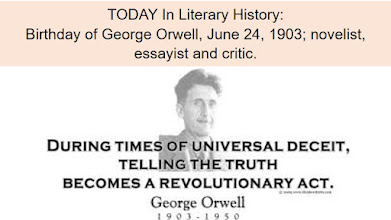
  Eric Arthur Blair (25 June 1903 – 1950, who used the pen name George Orwell, was an English novelist, essayist, journalist, and critic. His work is marked by lucid prose, awareness of social injustice, opposition to totalitarianism, and outspoken support of democratic socialism. Orwell wrote literary criticism, poetry, fiction, and polemical journalism. He is perhaps best known for his dystopian novel Nineteen Eighty-Four (1949) and the allegorical novella Animal Farm (1945). His non-fiction works, including The Road to Wigan Pier (1937), documenting his experience of working class life in the north of England, and Homage to Catalonia (1938), an account of his experiences in the Spanish Civil War, are widely acclaimed, as are his essays on politics, literature, language, and culture. In 2008, The Times ranked him second on a list of "The 50 greatest British writers since 1945".   Orwell's work continues to influence popular and political culture, and the term Orwellian—...
Image
   Birth of Erich Maria Remarque, German novelist.  His best-known novel All Quiet on the Western Front (1928), about German soldiers in the First World War, was made into an Oscar-winning movie. His book made him an enemy of the Nazis, who burned many of his works. The book describes the German soldiers' extreme physical and mental stress during the war, and the detachment from civilian life felt by many of these soldiers upon returning home from the front. Remarque was a surprisingly thoughtful, and clearly extremely intelligent person with an extremely sensitive soul and subtle talent. His books are startlingly frank expressions of real feelings as well as vivid characters that sprang from the author’s own life and heart. In Remarque’s novels, love is passionate, all-consuming and immortal. ’His’ war is terrible, it breaks one’s will, faith, and fate. His books are about a lost generation — ’lost’ in the sense that its inherited values were no longer relevant in the po...